What is the Prop 65 warning on CoreJava?
The warning on CoreJava required by the state of California reads:
Why is this warning on CoreJava?
At MarketPlace Global, we make sure our products comply with the regulations that apply where they are sold. Core Java is fully compliant with California’s Proposition 65 warning requirements, and we are committed to delivering high-quality products to our customers.
Many plant materials contain naturally occurring lead, because it is commonly found in the environment, including the soil, air, and water. Core Java’s coffee and botanical ingredients absorb trace amounts of lead from the soil they are grown in.
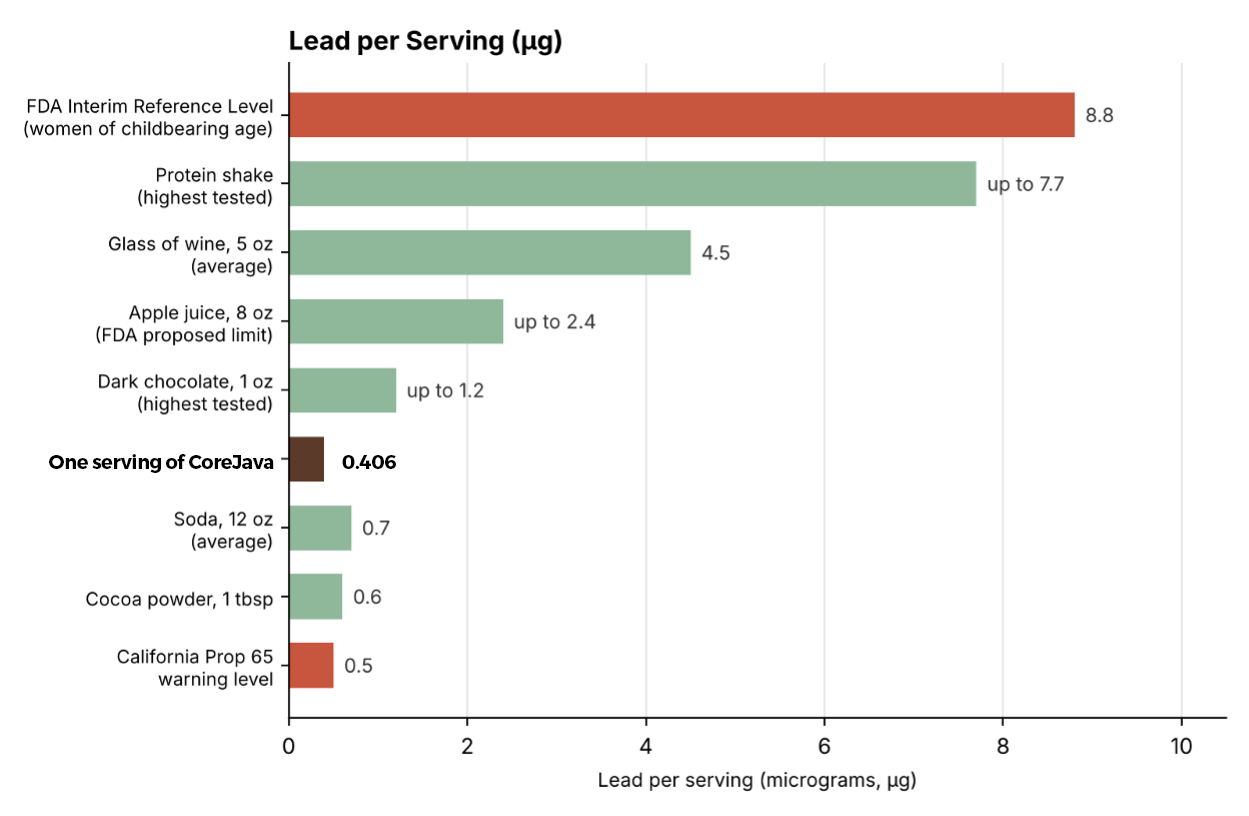
Independent laboratory testing found approximately 0.406 µg of lead per serving, which is below California's Proposition 65 warning threshold of 0.5 µg per day for reproductive toxicity.
However, lead exposure increases with each additional serving consumed. Drinking two servings would result in approximately 0.812 µg of lead exposure, exceeding California's warning threshold.
For this reason, we recommend following CoreJava's directions and limiting consumption to one serving per day.
Should I be concerned?
It is always important to read product packaging and warnings, especially for products with ingredients that are new to you.
Proposition 65 warning levels are significantly lower than FDA reference levels. A Proposition 65 warning is not a product recall or a determination by the FDA that a product is unsafe.
While testing indicates that one serving of CoreJava contains less lead than California's Proposition 65 warning threshold for reproductive toxicity, consuming multiple servings increases your total exposure.
We recommend using CoreJava as directed: one serving per day.
CoreJava is not intended for children. If you are pregnant, nursing, or taking medication, consult your healthcare provider before use.
Why don't I see this warning on all products?
It is up to each business to determine whether its products require a Prop 65 warning. A business that does not provide a required warning may be at risk of a Prop 65 lawsuit. Businesses with fewer than 10 employees and government agencies are exempt. A business does not need to provide a warning if a product’s exposure level is below California’s warning level.
Why am I seeing this warning label if I'm not in California?
While the warning is only required in California, some brands include it on products sold in every state. Core Java is sold nationwide through our Independent Sales Representatives, so we make this page available for everyone to view.
Sources:
- U.S. Food and Drug Administration. Lead in Food and Foodwares. www.fda.gov/food/environmental-contaminants-food/lead-food-and-foodwares
- Flannery, B.M., et al. U.S. FDA’s interim reference levels for dietary lead exposure in children and women of childbearing age. Regulatory Toxicology and Pharmacology 110 (2020). doi.org/10.1016/j.yrtph.2019.104516
- U.S. Food and Drug Administration. Draft Guidance for Industry: Action Levels for Lead in Juice (April 2022).
- Towle, K.M., Garnick, L.C., Monnot, A.D. A human health risk assessment of lead (Pb) ingestion among adult wine consumers. International Journal of Food Contamination 4, 7 (2017). doi.org/10.1186/s40550-017-0052-z
- Independent testing of protein powders (2025), dark chocolate (2022), and cocoa products (2023). [Source attribution pending — see internal notes]
- Tahvonen, R. Lead and cadmium in beverages consumed in Finland (1998).
- www.P65Warnings.ca.gov/food